

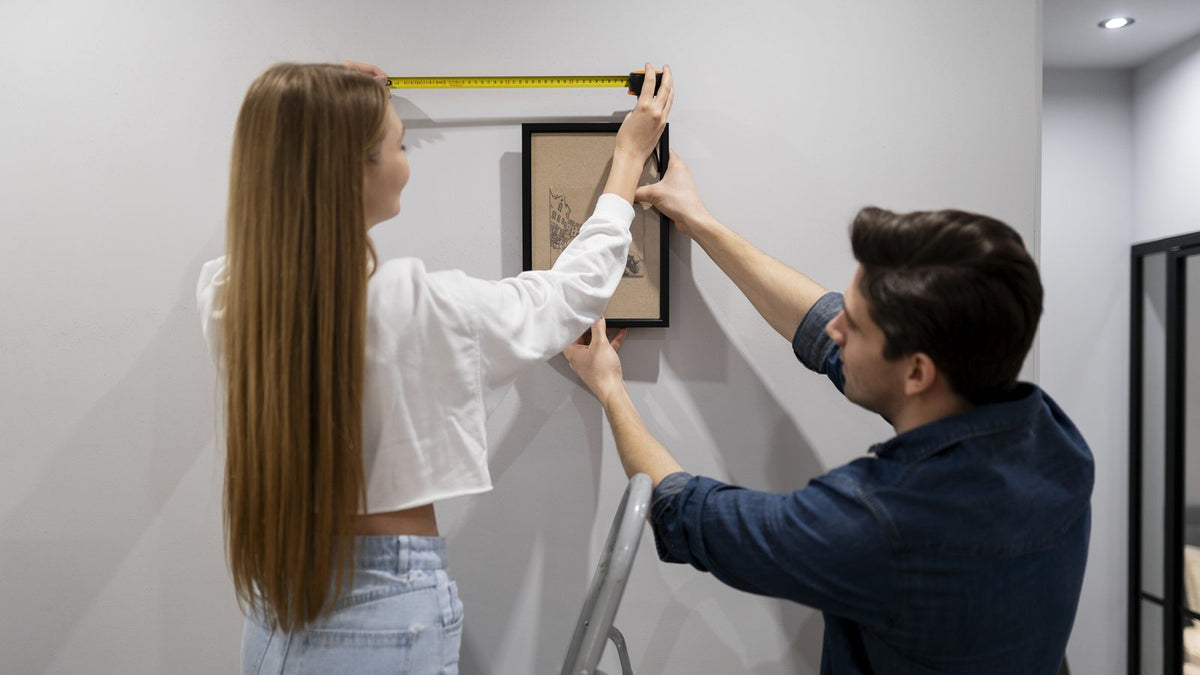
To get the size of a picture right, start from the width of the furniture below it: the picture should cover about two thirds of it. For height, aim for a centre point 145 cm (57 in) from the floor on a bare wall, or leave around 20 cm between the back of the sofa and the bottom of the frame. Here are those guidelines applied to our five sizes.
Designs available in large sizes


Your photo becomes a watercolour, landscape format


We turn your dog’s photo into a drawing in coloured pencils


The Vieux-Port and Notre-Dame-de-la-Garde through a trompe-l’œil window


Measure the furniture before choosing the picture
Most interior design guides start from the same point: a picture hung above a piece of furniture takes up roughly two thirds of its width. Any narrower and it looks lost on the wall; as wide as the furniture and it overwhelms it and throws the whole thing off balance. A 90 cm sideboard therefore calls for an image about 60 cm wide, and a 1.80 m sofa for an arrangement of about 1.20 m.
The calculation is based on width, not area. Grab a tape measure, note the width of the furniture and multiply it by two thirds: that gives you the target width. Then choose the orientation. A landscape design is wider than it is tall and stretches along the back of a sofa; a portrait design rises towards the ceiling and suits narrow stretches of wall.
With no furniture below, work from the wall itself: a small image on its own in the middle of a large white wall seems to float. It is better to go up one or two sizes, or to group several designs so they read as a single arrangement.
Our five sizes, from the bedside to a large wall
Applied to our sizes, the two-thirds rule gives the following match. The third column shows the width of the image depending on the orientation of the design; the fourth, the furniture width that this size in landscape fits perfectly.
| Size | Dimensions | Width in landscape / portrait | Furniture of about | Where to hang it |
|---|---|---|---|---|
| Small | 30 x 20 cm | 30 cm / 20 cm | 45 cm | Above a bedside table, on a shelf, in a hallway series |
| Medium | 40 x 30 cm | 40 cm / 30 cm | 60 cm | Above a narrow console table, a child’s desk, next to a door |
| Large | 60 x 40 cm | 60 cm / 40 cm | 90 cm | Above a chest of drawers, a low sideboard or a single bed |
| XXL | 80 x 60 cm | 80 cm / 60 cm | 120 cm | Above a small sofa, a large sideboard or a headboard |
| Giant | 120 x 80 cm | trompe-l’oeil windows, in portrait: 80 cm | 120 cm (portrait) | On its own on a large wall, above a hallway console table |
Depending on the design, not every size or print type is available: each product page shows its own. The Giant size, at 120 x 80 cm, is only offered on some of our designs, including our trompe-l’oeil windows, which are designed in portrait format. To compare all our wall art at a glance, from a photo or designed online, head to our personalised wall art.
How high should you hang a picture?
On a bare wall, the most widely used guideline comes from museums: the centre of the work sits 57 inches from the floor, or 1.45 m, which matches the eye level of a standing adult. Some guides go up to 1.52 m (60 in). Either way, you measure to the middle of the picture, not to its top edge or to the nail.
To work out where to put the nail, take three measurements. Take half the height of the picture, subtract the distance between its top edge and the hanging point on the back, then add 145 cm. For an 80 x 60 cm picture hung in landscape, so 60 cm tall, with a hanging point 5 cm from the edge: 30 minus 5, plus 145, the nail goes 1.70 m from the floor.
Several designs grouped together are treated as one: it is the centre of the arrangement that aims for 1.45 m. Between two neighbouring pictures, keep an even gap of 5 to 15 cm so the eye links them.
Above the sofa, the bed, a chest of drawers, in a hallway
As soon as there is furniture under the picture, the furniture sets the height. You no longer aim for 1.45 m but for a gap of around 20 cm (8 in) between the top of the furniture and the bottom of the frame (the guides we consulted range from 10 to 25 cm). Any higher and the picture comes adrift from the furniture, and each looks as if it stands alone.
Above the sofa
For a small sofa of about 1.20 m, the 80 x 60 cm in landscape matches the two thirds. Our watercolour portrait from your photo, in landscape format works well here: choose it in 80 x 60 cm, on canvas, acrylic glass, framed or as a poster, and allow 20 cm between the back of the sofa and the bottom of the image. Most of our portraits from photos come in both landscape and portrait. A 2 m three-seater sofa would need 1.30 m of width, more than our landscape designs: in that case, hang two designs side by side, in the same size and print type, for example two 60 x 40 cm in landscape about 10 cm apart.
Above the bed
A 140 cm wide bed calls for an arrangement about 93 cm wide. The 80 x 60 cm in landscape comes close; two 60 x 40 cm in portrait, hung side by side 10 cm apart, come to exactly 90 cm. Keep the same 20 cm or so between the headboard and the bottom of the frame.
Above a chest of drawers
A 90 cm chest of drawers pairs with 60 cm of width: a 60 x 40 cm in landscape, or an 80 x 60 cm in portrait, which is also 60 cm wide. The second option suits the coloured pencil portrait of your dog, shown upright: it fills the wall without going beyond the width of the furniture.
In a hallway
In a narrow passage, you see the walls up close and on the move. Go for the Small to Large sizes, lined up on the same centre line at eye level, with identical gaps from one frame to the next; some guides place that line a little higher in a hallway. Three designs in 40 x 30 cm, in the same orientation and print type, often read better than one large size, which you cannot step back far enough to see in full.
On a large wall, the Giant size
A tall, clear wall, between two doors or above a 1.20 m hallway console table, can take the 120 x 80 cm: our windows in this size hang in portrait. On its own on the wall and centred at 1.45 m, it goes down to 85 cm from the floor and up to 2.05 m; placed above a console table, it goes higher still: check your ceiling height before ordering. Our trompe-l’oeil window onto the Old Port of Marseille comes in this size, as a canvas print, a premium canvas (4 cm stretcher frame) or acrylic glass, and the window style is chosen on the product page, or removed to keep only the view.
And how do you hang a picture without drilling?
A few general pointers that apply to any picture. As for print types, a canvas print on its stretcher frame hangs as it is, without a frame, and a poster can be framed to your taste. If drilling into the wall is out of the question, the simplest solution is to stand the picture on a chest of drawers, a mantelpiece or a shelf, leaning against the wall. Adhesive hooks and strips sold in shops are another option: read the weight limit on the packaging, and keep this kind of fixing for lightweight sizes.
Before you order, try it on the wall
Before settling on a size, cut out a rectangle of paper to its dimensions, or mark it on the wall with masking tape. Stuck at the right height, it shows you in a second whether 60 x 40 cm is enough or whether you need to go up to 80 x 60 cm, and then it comes off. Leave it up for a while: you will see it as you walk past, from the sofa, from the door.
Once the size is decided, all that remains is choosing the material: our comparison of print types puts canvas, acrylic glass, poster and framed print side by side. And if your picture starts from a photo, our guide to portraits from photos helps you choose the style and the image to send.
Frequently asked questions
What is the right height to hang a picture?
Measure to the centre of the picture: it should sit around 1.45 m (57 in) from the floor, the eye level of a standing adult, which museums use as their reference line. Other guides aim for 1.52 m. Above furniture, the rule changes: allow around 20 cm between the furniture and the bottom of the frame.
How do you hang a picture without drilling?
The simplest way is to stand the picture on a piece of furniture, a shelf or a mantelpiece, leaning against the wall. Adhesive hooks and strips from the shops work for lightweight sizes, as long as you respect the weight limit stated on the packaging. A canvas print on its stretcher frame, which hangs as it is, can also simply stand on a sideboard.
What size picture for a living room?
It all depends on the furniture below it. Above a sofa, a sideboard or a console table, the picture covers about two thirds of its width: 80 cm for a 1.20 m piece of furniture, 60 cm for a 90 cm one. Above a long sofa, two designs side by side replace a very large size.
Should a living room picture be landscape?
Above a sofa or a sideboard, landscape format follows the line of the furniture and reaches two thirds of its width more easily. Portrait format comes into its own on a narrow stretch of wall, between two doors or above a chest of drawers. Many of our portraits from photos come in both orientations.


