

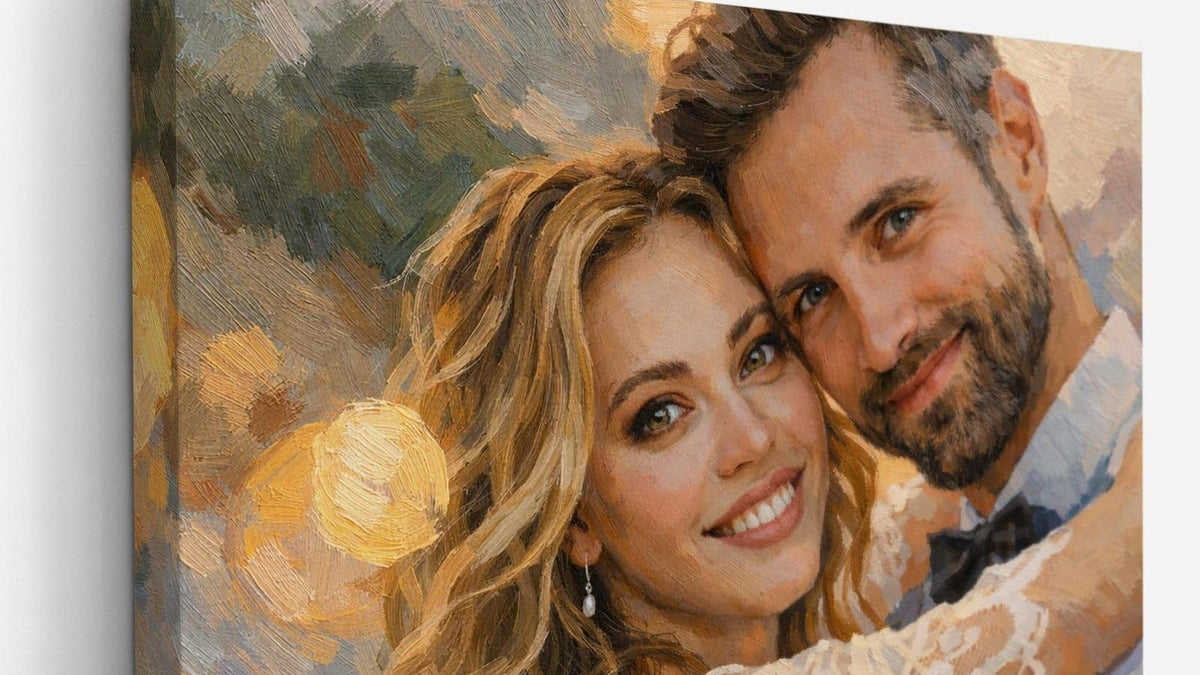
For a photo to hang on the wall, a canvas print looks like a painting, with nothing in front of the image; acrylic glass deepens the colours under an ultra-glossy surface; the poster, the lightest option, slips into a frame; the framed print combines the poster with its wooden frame. The right choice depends on the photo first, then on the room.
The designs featured in this guide


Your photo in the style of an oil painting, landscape format


We turn your dog’s photo into neon street art on a black background


Royal portrait from your photo, as a King of Prussia


We turn your cat’s photo into a colour memorial portrait


Your child as an ocean superhero from their photo, Super Aqua


Your car from its photo, as a car designer’s sketch


Canvas, acrylic, poster or framed print: the four compared at a glance
On our wall art, you choose the print type in the configurator, just after uploading your photo: poster on photo paper, canvas print, acrylic glass or framed print. All four start from the same image. What changes is the surface, what sits in front of the image and how you hang it at home.
| Criterion | Canvas print | Acrylic glass | Poster | Framed print |
|---|---|---|---|---|
| Material | 285 g/m² canvas stretched over a wooden stretcher frame | 3 mm thick acrylic sheet with rounded corners | 265 g/m² photo paper, printed borderless | The poster in a bevelled wooden frame, in white, black, dark wood or light wood |
| Finish | Soft, the look of a painting | Ultra-glossy, intense colours, deep blacks | Matt finish | That of the poster, set off by the moulding |
| In front of the image | Nothing, the printed canvas stays bare; UV filter | The sheet itself, which reflects the light | Nothing, a matt paper with no reflections | An acrylic glazing panel |
| Best room | Living room, bedroom, above a sofa | Hallway, landing, study, dimly lit wall | Bedroom, gallery wall, small space | Study, hallway, wall of family photos |
| Hanging and transport | Hangs without a frame, can also stand on a sideboard; sent in a box with bubble wrap | Sent protected by a box and bubble wrap | The lightest; travels rolled in a tube, to frame at home | Sent protected by a box and bubble wrap |
| Sizes | From 30 x 20 to 80 x 60 cm depending on the design; some go up to 120 x 80 cm (about 47 x 31.5 in) on canvas or acrylic glass, with an extra option of a canvas on a 4 cm deep stretcher frame | |||
Canvas or acrylic glass: the softness of a painting, or the shine
On its wooden stretcher frame, a canvas print hangs with no frame around it, and its soft finish suits images that imitate painting. A family, couple or friends photo turned into an oil-painting-style portrait, in landscape format, comes into its own here: the thick brushstrokes and golden light of the style read like a living room painting, with no gloss to break them up.

Acrylic glass works the other way round. The acrylic sheet covers the image with an ultra-glossy surface: colours gain intensity and dark backgrounds gain depth. A design on a black background makes the most of it, like your dog in neon street art style, on a night-time wall, whose fluorescent drips stand out sharply from the black. Its rounded corners give it a clean look, with no moulding.

In large sizes, canvas and acrylic glass go up to 80 x 60 cm on most of our designs. Our trompe-l’oeil window prints go up to 120 x 80 cm, with a canvas on a 4 cm deep stretcher frame that gives more depth on the wall. To work out what size picture you need above a sofa or a headboard, see our guide to picture sizes and hanging height.
Poster or framed print: which frame for a poster?
The poster is printed on 265 g/m² photo paper with a matt finish, borderless. It is the lightest and most flexible option: it goes into a frame you already own, fits into a gallery wall of mismatched frames, or moves around whenever you fancy a change.

To frame it yourself, start from the exact dimensions of the size you ordered: a 40 x 30 cm frame for a 40 x 30 cm poster, and the same for 30 x 20, 60 x 40 and 80 x 60 cm.

The framed print saves you that step: the poster arrives in a bevelled wooden frame, with acrylic glazing in front of the image, in four finishes: black, white and two woods, one light, one dark. Black draws the eye to the image, white lightens it on a pale wall, and the two woods warm it up. A regal portrait as a King of Prussia, from your photo, in dark wood, finds its place among the shelves of a study, between the history books.
Room by room, the right print for the wall
In a very bright living room
Opposite a large window or patio doors, a very glossy surface reflects the window and blurs the image. On that wall, choose canvas, which has nothing over it, or a matt poster. Acrylic glass still has its place in the same room, on a wall at right angles to the windows: daylight brings out the colours there while limiting reflections.
In a hallway or landing with no window
Where light is scarce, acrylic glass makes up for it: its gloss catches the slightest lamp and livens up a dark wall, as long as the lamp is not directly opposite. A canvas also works there, if a lamp lights it directly.
In a bedroom, for adults or children
A bedroom is mostly seen in the evening, under a bedside lamp. Canvas sits happily above the headboard. When a family pet has passed away, the colour memorial portrait of your cat, created from its photo against a pastel sky, can be looked at up close, from the pillow, with nothing between you and it.
In a child’s room, the poster has two advantages: it weighs very little, and it can change frame when the room is redecorated. Your child’s portrait as Super Aqua, a hero of the seas born from their photo, works well in portrait format; on canvas, it hangs straight on the wall, with no frame needed.
For a gift that has to travel
A gift that has to fit in a suitcase or be passed around at a party: the poster is the easiest to carry. It travels rolled in a tube, while canvas, framed prints and acrylic glass are sent in a box, wrapped in bubble wrap. For a car enthusiast, a drawing of their car in the style of a car designer, from their photo, packs easily into luggage as a poster. If the person lives far away, the HD digital version, offered as an extra on many designs, is sent by email: you can forward it to them, and the image arrives before the print.
Our advice: start with the photo, then the wall
When in doubt, we look at the image first. Bright colours, a dark background, neon: acrylic glass. A style that evokes painting, a watercolour, an oil: canvas. A series of memories you want to rotate in frames already on the wall: poster. A complete portrait to give, with nothing else to buy: framed print. Only then do we check the wall: a window opposite, the space available, the evening light.
For the style of the transformation and the photo to send us, our guide to portraits from photos takes over. All our designs to hang are gathered in our personalised wall art, and couple, family and friends portraits in our portraits from photos.
Frequently asked questions
Canvas or poster: which should you choose?
A canvas print on a wooden stretcher frame hangs as it is and gives the photo the look of a painting. A poster, on matt photo paper, weighs less, but it needs a frame: your own, or the one in the framed version. For a large living room wall, choose canvas; for a bedroom or a gallery wall, a poster.
Canvas or framed print: what is the difference?
A canvas print is stretched over a wooden frame and hangs with nothing in front of the image. A framed print is our poster, on 265 g/m² photo paper with a matt finish, printed borderless, placed in a bevelled wooden frame behind acrylic glazing. The real decision lies elsewhere: the soft look of a painting, or a classic frame, in a small size for a shelf or a large one for a whole wall.
What is a canvas print?
It is an image printed on canvas instead of paper, then stretched over a frame. Ours is 285 g/m² canvas on a wooden stretcher frame, with a UV filter. It hangs without a frame or glass, and its soft finish recalls a painting. Its size depends on the design, up to 120 x 80 cm for the largest.
Can you get a painting effect on canvas from a photo?
Yes, by choosing a design where the photo is first given a style, oil painting or watercolour for example, before being printed on the canvas. The effect comes from the image printed on the canvas: you see the brushstrokes of the style, with no texture added on top. The faces stay those of the photo you sent us.


